From FSS to GBS: How Finance and Accounting Outsourcing Enables AI-Driven Finance Transformation
Article
Building a successful Finance Shared Services (FSS) model is a major milestone, but for many organizations, it is now becoming the launchpad for something bigger.
As finance operations grow more connected, data-driven, and strategic, businesses are increasingly turning to automation and AI to scale from traditional Shared Services Center (SSC) structures into more agile, integrated Global Business Services (GBS) environments – with finance and accounting outsourcing helping accelerate that transformation. Here’s how forward-looking organizations are building on shared services success to unlock the next stage of finance maturity…
What is the difference between a Shared Service Centre (SSC) and Global Business Services (GBS)?
SSC centralizes functions for efficiency, while GBS integrates multiple functions, technologies, and workflows into a unified enterprise services model.
The Evolution from SSC to GBS
The original Shared Services model transformed enterprise finance operations by bringing consistency, control, and efficiency to fragmented processes. By centralizing transactional finance activities into shared services centers, organizations improved governance, reduced duplication, and created scalable operating foundations across geographies. That foundation remains incredibly valuable today. In fact, many organizations could not realistically pursue mature GBS strategies without the operational discipline established through Finance Shared Services in the first place.
However, enterprise expectations have evolved significantly. Modern finance functions are increasingly expected to deliver:
- Faster business insight
- Real-time visibility
- Predictive analytics
- Stronger compliance oversight
- Agile reporting capabilities
- Better stakeholder experiences
- Strategic business partnership.
Unlike traditional SSC structures, which often focus primarily on functional efficiency, GBS connects functions, workflows, technologies, and governance into a more integrated enterprise-wide operating model. Finance no longer operates as a standalone delivery function, instead, it becomes part of a broader ecosystem where data, automation, and processes flow more seamlessly across the organization.
Why AI and Automation Becomes Essential at the GBS Stage
Many Finance Shared Services environments already utilize some level of automation – invoice processing, workflow approvals, reconciliations, and reporting automation. But isolated automation alone does not necessarily create finance maturity. The move towards GBS requires organizations to think differently about how automation operates across the enterprise. Rather than simply accelerating individual tasks, automation begins supporting end-to-end operational orchestration.
This distinction matters enormously. In traditional Shared Services organizations, automation may sit within individual processes. In mature GBS environments, automation connects workflows across functions, reduces friction between teams, improves data visibility, and enables more intelligent service delivery at scale. This is where organizations begin moving beyond task automation towards:
- Intelligent workflow orchestration
- AI-enabled forecasting
- Real-time reporting environments
- Predictive financial operations
- Automated compliance controls
- Self-service finance capabilities
- Intelligent exception management
- Enterprise-wide analytics integration.
The outcome is not simply faster processing, but a more connected, responsive, and scalable finance function.
How does automation support finance maturity?
Automation reduces manual effort, improves reporting accuracy, accelerates workflows, and allows finance professionals to focus on more strategic activities.
The AI Layer: Moving from Efficiency to Intelligence
The role of AI within finance and accounting outsourcing has evolved rapidly. Initially viewed primarily as a productivity tool, AI is now becoming a strategic enabler within modern finance operations. This is particularly relevant within GBS environments, where large volumes of interconnected operational and financial data create opportunities for much deeper enterprise insight.
AI is helping finance teams and GBS leaders move beyond retrospective reporting towards predictive and proactive decision-making. Examples include:
- Detecting anomalies before they become compliance risks
- Improving forecasting precision
- Predicting supplier payment risks
- Enhancing cash flow analysis
- Supporting automated financial narrative generation
- Prioritizing exceptions based on business impact
- Strengthening audit readiness
- Accelerating reconciliations.
Importantly, the value of AI is not solely about efficiency gains or cost reduction. In many cases, the greatest benefit lies in improving decision quality while allowing finance professionals to focus on more strategic activities rather than repetitive administration. This is one reason why finance and accounting outsourcing strategies are also evolving. Today, organizations increasingly seek F&A outsourcing partners capable of delivering not only operational support, but also automation capability, AI integration expertise, analytics enablement, and transformation support.
Why are Finance Shared Services evolving towards GBS?
As enterprise operations become more interconnected and data-driven, organizations require more integrated, agile, and scalable operating models that support both efficiency and strategic value creation.
Why the SSC-to-GBS Journey Requires Process Redesign
One of the biggest misconceptions in finance transformation is the belief that automation alone creates operational maturity. In reality, automation works best when built on standardized, well-governed processes.
This is why many SSC-to-GBS transformation programmes prioritise process harmonisation before large-scale automation deployment. Without process consistency, organizations risk digitising inefficiency rather than eliminating it. This is where a Global Process Owner (GPO) comes into their own. Common transformation barriers they work to overcome include:
- Legacy ERP fragmentation
- Inconsistent process ownership
- Siloed governance structures
- Over-customised workflows
- Poor data quality
- Fragmented regional processes
- Change management resistance
- Disconnected technology ecosystems.
Successful GBS environments typically focus first on operational coherence. Once workflows are aligned and governance is standardized, automation and AI can scale much more effectively across the enterprise. This sequencing matters – the most mature finance organizations do not simply automate individual activities, but redesign how work flows across the business itself.
Signs Your Finance Shared Services Model Is Ready for GBS
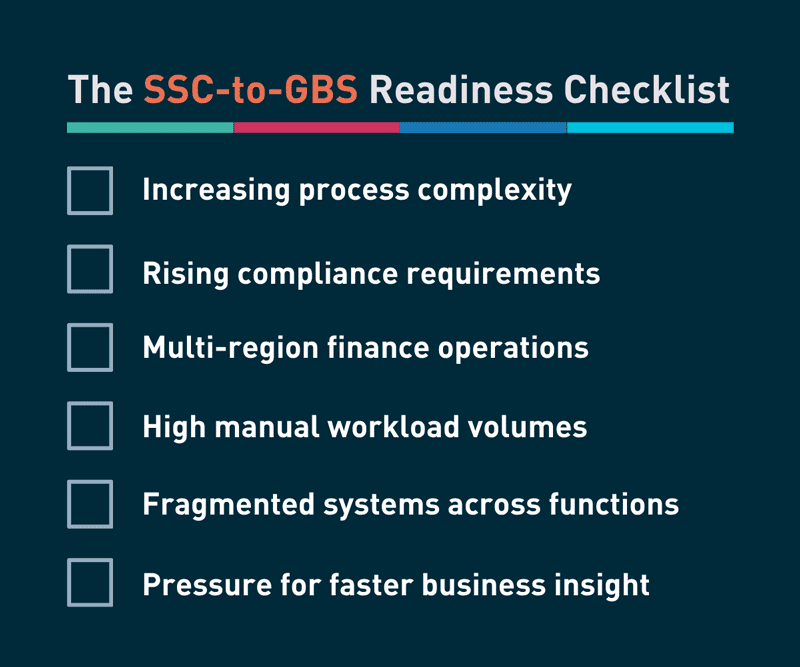
As finance operations become more complex and interconnected, many organizations reach a point where traditional Shared Services models begin evolving towards a more integrated GBS approach. If several of the signs below sound familiar, it could indicate that your Finance Shared Services operation is ready for its next stage of maturity. How many of these can you tick off?
The Expanding Role of Finance and Accounting Outsourcing
As finance transformation becomes more complex, many organizations are recognizing that they need broader operational and technological support to accelerate maturity. This is driving renewed interest in outsourcing, particularly among enterprises seeking to modernize Finance Shared Services while maintaining operational continuity.
However, the role of F&A outsourcing has evolved significantly. Traditional outsourcing models focused heavily on labor arbitrage and transactional processing efficiency. Modern FAO partnerships increasingly focus on enabling transformation itself, with contemporary finance and accounting outsourcing providers expected to support:
- Automation implementation
- AI integration
- Process optimization
- Analytics capability
- Governance support
- Workforce scalability
- Continuous improvement initiatives.
This becomes particularly valuable during SSC-to-GBS transitions, where organizations must simultaneously maintain service delivery while modernizing operations. The right F&A outsourcing partner can help reduce transformation risk while accelerating operational maturity.
Talent Transformation is Reshaping Finance Operations
Another major driver behind the shift from SSC to GBS is the changing nature of finance talent itself. As automation absorbs repetitive and transactional activities, finance roles are becoming increasingly analytical, strategic, and technology enabled. This creates both opportunity and pressure for organizations. Finance leaders must now:
- Modernize operational delivery
- Improve employee experience
- Upskill finance teams
- Reduce administrative burden
- Maintain compliance standards
- Deliver stronger business insight.
Automation supports this transition by allowing finance professionals to focus on higher-value work rather than manual processing. In many cases, this also improves employee engagement and retention. As finance professionals spend less time on repetitive administration and more time on analysis, stakeholder collaboration, and strategic support, the finance function becomes more attractive as a long-term career environment (this is particularly important as competition for digitally skilled finance talent continues to increase globally).
What does a future-ready finance function look like?
A future-ready finance function combines AI, automation, and integrated operating models to improve agility, scalability, visibility, and decision-making. Modern finance organizations are increasingly focused on building operations that can adapt quickly to change, support business growth, strengthen compliance, and enable more strategic finance delivery.
What Mature GBS Finance Functions Tend to Have in Common
While every organization approaches transformation differently, mature GBS finance environments often share several characteristics:
- Standardised Global Processes – Processes are harmonised across regions, enabling greater consistency and automation scalability
- Integrated Technology Ecosystems – ERP platforms, automation tools, analytics environments, and workflow systems operate cohesively rather than independently
- Embedded Automation – Automation operates across workflows rather than within isolated process pockets
- Strong Governance Structures – Clear accountability and enterprise-wide governance improve operational consistency
- Real-Time Data Visibility – Finance leaders gain faster access to operational and financial insight
- Human-AI Collaboration – AI enhances decision-making while finance professionals focus on strategic analysis and relationship management.
Most importantly, mature GBS models position finance as an active contributor to enterprise agility rather than purely a support function.
The Future of Finance Maturity
The evolution from SSC to GBS reflects a broader shift in how finance creates value. While Shared Services laid the foundation for scale and efficiency, modern finance organizations are now expected to be more connected, agile, intelligent, and insight-driven – powered increasingly by automation, AI, and integrated operating models.
For organizations with established Finance Shared Services operations, the move towards GBS is not about replacing what works but building on it. Increasingly, the finance functions that scale most successfully are those combining intelligent automation, integrated workflows, and strategic service delivery to support long-term agility, resilience, and growth.
We provide comprehensive Finance and Accounting support, freeing your Finance teams to focus on value not volume.
Learn more about our capabilities and capacities or contact us to find out more about how we can help you with your Finance and Accounting outsourcing needs.