Overview: Building Resilience with a Shared Services Outsourcing Partner
Shared services outsourcing can play a critical role in helping organizations build business resilience as they scale. But as operations grow, leadership teams must confront critical questions:
- Could the business operate if its primary offshore delivery location became unavailable?
- Does its outsourcing partner have proven multi-location delivery capability?
- Is resilience being built proactively, or only tested when disruption occurs?
ADEC Innovations had served as the client’s shared services outsourcing partner since 2007, delivering services from its site in Manila, Philippines. Payroll, benefits administration, HR, and finance and accounting operations were stable, efficient, and high performing. Robust business continuity plans were in place, aligned with ISO 22301 and supported by ISO 27001-certified information security controls, incorporating risk-based planning, audits, and best practices.
In 2024, as ADEC’s client, a U.S.-based Professional Employer Organization, entered a new phase of growth these questions became increasingly urgent. A solid business resilience strategy was required, one that went beyond Business Continuity Planning (BCP), ensuring business-critical operations remain protected against even unlikely disruption.
The Challenge: Reducing Geographic Risk in a Shared Services Model
As the PEO client’s operations grew, both organizations recognized that long-term resilience would require more than strong performance in a single location. Reliance on one geographic region created exposure to weather-related, such as typhoons, and geopolitical shifts that no BCP document fully neutralizes.
The objective was clear: expand shared services outsourcing into a second location to reduce geographic concentration risk while maintaining continuity, service quality, operational control, and cost efficiency.
The client’s shared services outsourcing model had become mission critical. Despite solid BCP processes across BPO, a single-region delivery model carried inherent risk. Leadership needed to be able to answer one key question:
What happens if we lose this region for just a few hours?
Not having a clear answer wasn’t acceptable.
The Solution: Why Outsourcing to Kenya Made Sense
Rather than building new capability from scratch, the client evaluated and visited several locations, including ADEC’s existing BPO operation in Kenya.
As an established BPO service provider in Kenya, ADEC already had the infrastructure, leadership, and governance in place to support expansion without introducing risk.
Kenya was selected based on:
- Continental diversification supporting a stronger business resilience strategy
- A strong English-speaking talent pool
- Competitive cost structures
- A mature BPO Kenya ecosystem
- Consistent operating standards aligned with global delivery models
This approach allowed the client to strengthen continuity without disrupting existing operations.
The “Mature + 1” Strategy for Operational Resilience
The delivery model paired an established location with an emerging one:
- Philippines: A mature market, strong BCP in BPO operations and proven performance
- Kenya: An emerging market offering scale, stability, access to skills, and geographic diversification
The logic is straightforward. Pairing a high-performing mature location with a second emerging site means neither location carries the full operational load. If one becomes unavailable, the other continues without interruption. It also avoids the risk of standing up an untested delivery site and depending on it immediately.
Outsourcing to Kenya: A Structured, Low-Risk Transition
ADEC applied a structured framework to assess which services should transition. Out of more than 1,500 processes, 380 were identified as suitable for immediate migration based on complexity, risk, and operational dependency.
Processes included:
- Payroll
- HR operations
- Benefits administration
- Accounting
- Tax
- Treasury
- Voice services
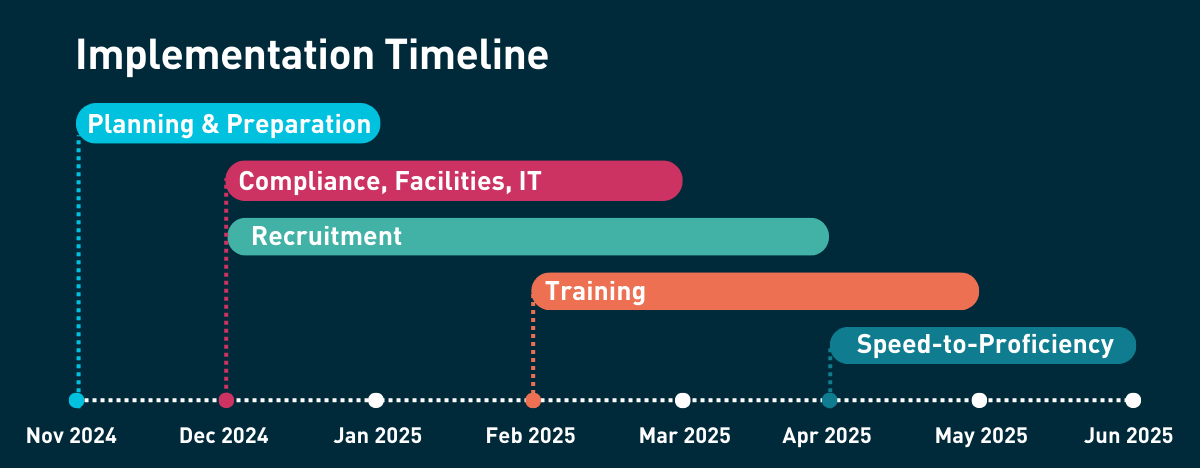
ADEC built a structured plan with phased timelines, clear milestones, and on-site training that brought key Manila leaders and several U.S. team members to Kenya to work directly with the new group. ADEC’s long-tenured Philippines team led knowledge transfer and training in Kenya, ensuring consistency, quality, and speed to productivity.
This approach enabled business process outsourcing in Kenya without disruption or service degradation.
Kenya Transition Roadmap
Results: Operational Resilience at Scale
Initial targets focused on rapid proficiency and SLA attainment for processes transitioned to Kenya. The first 90 days were completed as planned, after which the rollout continued to include additional in-scope services.
The result was a fully operational dual-location delivery model, implemented in just seven months.
Key outcomes included:
- 380 processes transitioned successfully
- 100% SLA achievement
- 99.98% quality accuracy
- Full productivity reached within weeks
- Zero service disruption
Today, the Kenya operation functions as a fully integrated extension of the client’s shared services outsourcing model, providing built-in business continuity and the flexibility to scale as needs evolve.
Impact Beyond Metrics
The expansion into Kenya delivered value beyond operational metrics. The Kenya operation provides continued cost efficiency, supporting competitive pricing and enabling sustainable growth within the PEO market.
Outsourcing to Africa also advances the client’s broader organizational objectives through Impact Sourcing practices. Recognized as an Impact Sourcing hub, ADEC’s Kenya operation employs talent from rural or marginalized communities, with strong representation of women and single parents. In addition, high workforce tenure and low attrition at the Kenya site demonstrate how inclusive hiring strengthens operational resilience and long-term performance.
This approach aligns with broader industry recognition of Impact Sourcing as a sustainable delivery model. For four consecutive years, ADEC Innovations has been featured in the Everest Group’s Impact Sourcing State of the Market report, including the 2025 edition, reinforcing long-term credibility of this model.
Conclusion: From Solid BCP to Genuine Resilience
This case study highlights a more mature way of thinking about resilience in shared services and outsourcing. Resilience is not only defined by the strength of documented plans or the number of controls in place. It is defined by whether the operating model has been deliberately designed to withstand unlikely, high-impact events before they occur.
For this client, those continuity questions now have clear answers. By working with ADEC Innovations as a trusted outsourcing partner, the client extended delivery beyond a single region, strengthened continuity, and built a model designed to scale without increasing risk. And resilience was built before it was needed.
For organizations asking the same questions, the starting point isn’t a new continuity plan. It’s an honest assessment of whether the operating model itself is the risk.